Backlink Submission Sites: What Still Works
Most “top 500 backlink submission sites” lists were written a decade ago and copied ever since. This one starts from what is still indexed and still passes value.
The short answer
Bulk backlink submission is finished. Submitting your URL to 500 directories does nothing in 2026, and it has done nothing for years. What survived is narrow: a handful of human-reviewed listings where the directory itself has readers, and the exchange model where you give something before you get a link.
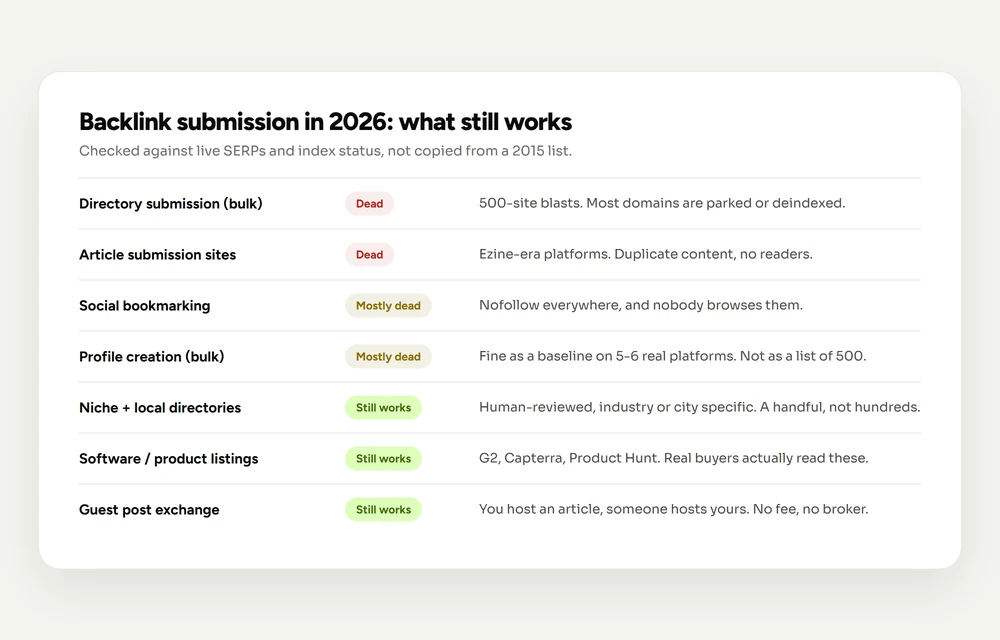
Why bulk submission stopped working
A directory passes value for the same reason any page does: it has authority, and its authority comes from people linking to it and reading it. The submission directories from the 2010s have neither. Run any of them through a backlink checker and you will find the same signature we found when auditing a spam-hit domain: a Domain Rating in the 30s or 40s, and zero organic traffic.
That combination is the tell. Authority without an audience means the authority was manufactured. Google worked this out long before the list-makers did.
The practical test takes ten seconds: search for the directory’s own name in Google. If the directory does not rank for anything, its outbound links are worth nothing to you.
Where submission still makes sense
Niche and local directories. Your industry association, your city’s business register, the two or three trade directories a buyer in your field would actually consult. These are reviewed by a human, they reject junk, and that rejection is exactly what makes the listing worth having.
Software and product listings. G2, Capterra and Product Hunt are not link schemes, they are places where buyers compare tools. The link is a side effect of being listed where your customers already look.
Platforms you were joining anyway. A GitHub profile, a company page on Crunchbase, an author page where you publish. These are the baseline every legitimate business has, and their absence is more noticeable than their presence.
The alternative most lists skip
Every backlink submission list stops at one-way submission: you fill in a form and hope. The category nobody covers is exchange, where you publish someone else’s article on your site and they publish yours.
That sounds like reciprocal linking, which Google does penalise, but the difference is direction. In a reciprocal pair, two sites link straight back at each other and the footprint is trivial to detect. In a network, your article goes on site B and site B’s article goes on site C. Every link points one way.
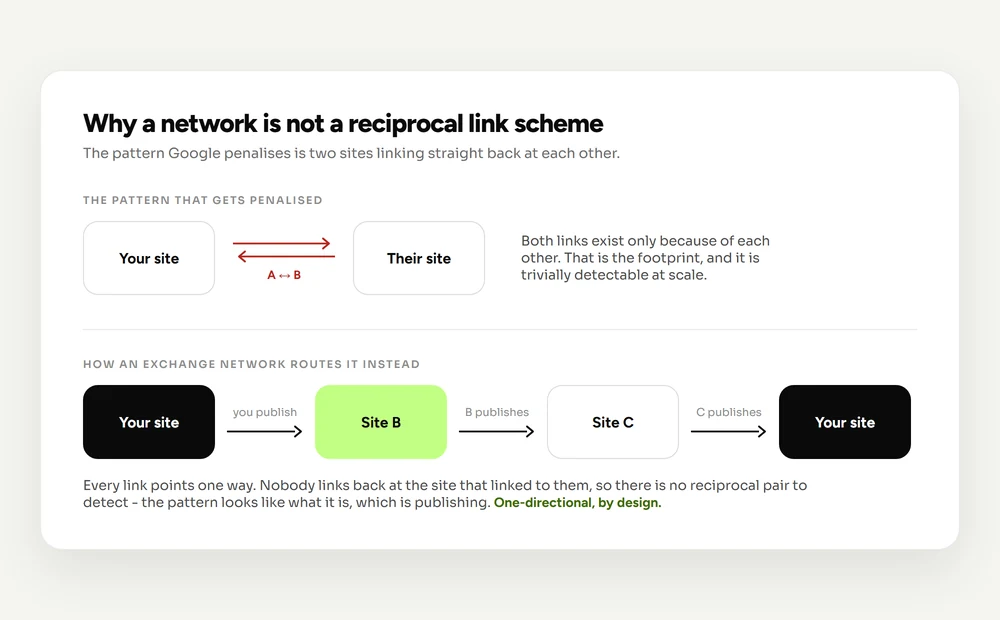
The failure mode of any exchange is quality control. If anyone can join, the network fills with the same dead domains as those directory lists and you are back where you started.
How Consolety handles that
Every publisher connects Google Search Console before joining. Consolety reads the real click and impression totals for that domain over the last 30 days, so you can see whether a site has an audience instead of trusting a Domain Authority score anyone can inflate. Search queries are never read.
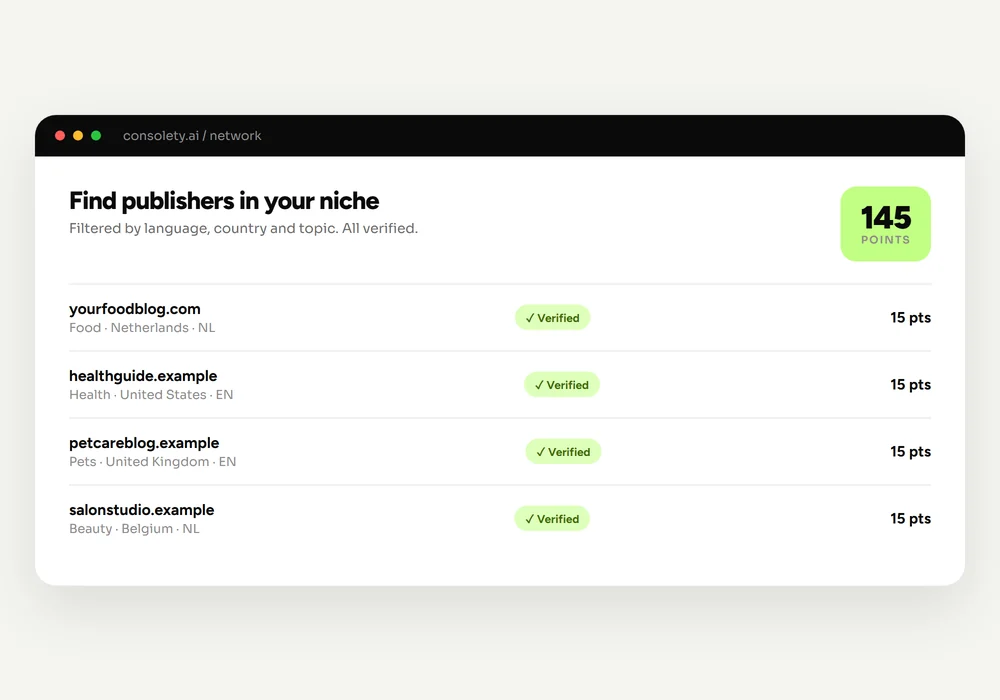
The plugin is free and on the official WordPress repository. There is no submission form and no invoice: you host an article to earn points, and spend points to publish your own.
Frequently asked
Is backlink submission bad for SEO? Bulk submission to low-quality directories can build a link profile that looks manufactured. It is rarely worth a penalty on its own, but it is worth nothing either, and cleaning it up later costs real time.
Are free backlink submission sites worth it? Free is not the problem. Traffic is. A free listing on a directory with readers is worth more than a paid one on a directory without them.
How many directories should I submit to? Between three and six, chosen because your customers use them. Not five hundred.
Related guides
Backlink exchange without the risk · Free backlinks: 12 ways that still work · How to get backlinks · What are backlinks