Backlinks Explained: From Basics to Strategy
Everything you need to know about backlinks — what they are, why they matter, and how to earn real ones that actually move the needle for your site.
What Are Backlinks?
A backlink is a link from one website to another. When Site A links to Site B, Site B has received a backlink from Site A. It is one of the simplest concepts in search engine optimization, yet it remains one of the most powerful ranking factors in 2026.
Think of backlinks as votes of confidence. When a website links to your content, it is essentially telling its audience — and search engines — that your page has something worth referencing. The more quality votes you collect, the more authority your site builds.
The terminology can be confusing. You will see backlinks called inbound links, incoming links, external links, or simply “links.” They all refer to the same thing: a hyperlink on someone else’s website that points to a page on yours.
The Anatomy of a Backlink
Every backlink has several components that determine its value:
- Source URL: The page where the link lives. A link from a high-authority page passes more value than one from a low-authority page.
- Destination URL: The page on your site that receives the link. This is the page that benefits from the backlink.
- Anchor text: The clickable text of the link. If someone links to your page with the text “best SEO tools,” search engines interpret that as a signal about what your page covers.
- Link attributes: HTML attributes like
rel="nofollow"orrel="sponsored"tell search engines how to treat the link. More on this in the types section. - Context: Where the link appears on the page matters. A link embedded naturally within a relevant paragraph carries more weight than one buried in a footer or sidebar.
Understanding these components is the first step toward building a backlink profile that actually improves your search rankings. But before we dive into strategy, let’s look at why backlinks carry so much weight in the first place.
Why Backlinks Matter for SEO
Backlinks have been a core ranking factor since the earliest days of Google. Larry Page and Sergey Brin built their original PageRank algorithm on a simple premise: pages that receive more links from other pages are likely more important and should rank higher.
That fundamental idea has not changed, even as the algorithm has grown enormously more sophisticated. Study after study confirms that backlinks remain one of the top three ranking factors alongside content quality and search intent matching.
Authority and Trust Signals
Search engines use backlinks to measure two critical qualities of a website: authority and trust.
Authority refers to how influential a site is within its niche. A website about fitness that receives backlinks from medical journals, sports publications, and well-known health blogs signals to Google that it is a credible source on fitness topics. This concept is closely related to what the industry calls domain authority — a metric that attempts to quantify a site’s overall link-based strength.
Trust is about legitimacy. Search engines want to surface results from real businesses and genuine experts, not from spam sites or content farms. Backlinks from trusted domains — government sites, educational institutions, established media — pass a trust signal that is difficult to fake.
Referral Traffic
Beyond SEO, backlinks drive direct referral traffic. A well-placed link on a popular blog or resource page can send hundreds or thousands of visitors to your site. This traffic is often highly qualified because visitors are clicking through from relevant content — they already have interest in your topic.
Indexing and Discovery
Search engine crawlers discover new pages by following links. If your site has very few backlinks, crawlers may take longer to find and index your new content. A healthy backlink profile ensures that search engines regularly visit your site, find new pages quickly, and keep your content fresh in their index.
How Does Your Backlink Profile Look?
Before you start building new backlinks, understand where you stand. Check your current backlink profile and see which links are helping — and which might be hurting — your rankings.
How Backlinks Work: The Mechanics
Understanding how backlinks work requires a look under the hood of search engine algorithms. While Google does not publish exactly how it weighs links, years of patents, statements from Google engineers, and independent research give us a clear picture.
Link Equity (Link Juice)
When a page links to another page, it passes a portion of its own authority to the linked page. This transfer is commonly called “link equity” or “link juice.” The amount of equity passed depends on several factors:
- The linking page’s own authority: A page with many high-quality backlinks of its own can pass more equity.
- Number of outbound links: If a page links to 100 different sites, each link passes less equity than if it linked to only 5 sites. The equity is divided.
- Relevance: A link from a page about SEO to another page about SEO passes more topical authority than a link from an unrelated page.
- Link placement: Links within the main body content typically pass more equity than links in headers, footers, or sidebars.
How Crawlers Follow Links
Google’s crawlers — programs called Googlebot — navigate the web by following links. When Googlebot arrives at a page, it reads the content and follows every link it finds. Each link is recorded and factored into Google’s understanding of the web’s structure.
This process creates a map of the internet where every page is a node and every link is a connection. Pages with many inbound connections from other well-connected pages naturally rise in importance. It is a system that mirrors how academic citations work — the most-cited papers are generally the most influential.
PageRank and Modern Link Analysis
Google’s original PageRank formula assigned a numerical score to every page based on the quantity and quality of links pointing to it. While Google no longer publicly shares PageRank scores, the underlying concept remains central to how rankings are determined.
Modern link analysis goes far beyond simple PageRank. Google now considers link velocity (how quickly you gain links), link patterns (natural vs. manipulative), topical relevance, and dozens of other signals. The algorithm has become remarkably good at distinguishing between links that represent genuine editorial endorsements and links that were placed artificially.
First Link Priority
An important technical detail: if a page links to your site multiple times, search engines typically count only the first link for equity purposes. The anchor text of that first link is what gets associated with your page. This is why the anchor text of your earliest and most prominent backlinks matters so much.
Internal vs. External Backlinks
This guide focuses on external backlinks — links from other websites to yours. But it is worth noting that internal links (links within your own site) also pass equity and help search engines understand your site structure. A strong internal linking strategy complements your external backlink efforts. For a deeper dive into building links strategically, see our complete guide to link building.
Types of Backlinks
Not all backlinks are created equal. Understanding the different types helps you prioritize which links to pursue and which to avoid.
Dofollow Backlinks
A dofollow backlink is a standard hyperlink with no special attributes telling search engines to ignore it. These links pass full link equity and are the most valuable type of backlink for SEO purposes. When people talk about “building backlinks,” they are usually referring to dofollow links.
By default, all HTML links are dofollow unless a rel attribute specifies otherwise. For a comprehensive look at why these links matter and how to earn them, read our guide on dofollow backlinks.
Nofollow Backlinks
A nofollow backlink includes the attribute rel="nofollow", which tells search engines not to pass link equity through this link. Google introduced this attribute in 2005 to combat comment spam.
However, in 2019 Google changed nofollow from a directive to a hint. This means Google may choose to consider nofollow links for ranking purposes in some cases. A natural backlink profile includes a mix of dofollow and nofollow links — having only dofollow links can actually look suspicious.
Sponsored Links
The rel="sponsored" attribute identifies links that were paid for, including advertisements and sponsorships. Google introduced this in 2019 as a more specific alternative to nofollow for paid links. Using this attribute for genuinely paid placements is considered best practice and keeps your link profile clean.
UGC (User-Generated Content) Links
The rel="ugc" attribute marks links that come from user-generated content, such as forum posts and blog comments. This helps search engines distinguish between editorial links placed by site owners and links placed by users in open comment sections.
Editorial Backlinks
These are the gold standard. An editorial backlink occurs when a journalist, blogger, or content creator links to your site because they genuinely find your content valuable. You did not ask for the link, you did not pay for it — someone discovered your content and decided it was worth referencing.
Editorial backlinks are difficult to earn at scale, but they carry the most weight because they represent authentic endorsement. Creating content that naturally attracts editorial links is one of the most sustainable SEO strategies.
Guest Post Backlinks
Guest posting involves writing an article for another website and including a link back to your own site within the content or author bio. When done correctly — writing genuinely valuable content for relevant, quality publications — guest post backlinks are a legitimate and effective link building tactic.
The key distinction is quality. A well-researched guest article on a respected industry blog is worlds apart from a spun article on a no-name site that exists solely to sell links. We cover this extensively in our guide to guest posting.
Resource Page Links
Many websites maintain resource pages — curated lists of helpful links on a specific topic. Getting your content included on relevant resource pages can provide strong, contextual backlinks. These links tend to be stable and long-lasting because resource pages are designed to be evergreen references.
Profile and Directory Links
Links from business directories, industry associations, and profile pages provide basic backlinks. While these typically carry less weight individually than editorial links, legitimate directory listings (Google Business Profile, industry-specific directories, chamber of commerce listings) contribute to a natural link profile and help establish your business as real and trustworthy.
Want Verified, Quality Backlinks?
Consolety connects you with real site owners for genuine guest posting opportunities. No PBNs, no link farms — just real editorial placements on verified websites.
What Makes a Good Backlink
With so many types of backlinks available, how do you determine which ones are worth pursuing? A good backlink shares several key characteristics.
Relevance
A backlink from a site in your industry or niche is far more valuable than a link from an unrelated site. If you run a SaaS company, a link from a technology blog carries more weight than a link from a cooking website. Search engines understand topical relationships and reward links that make contextual sense.
Relevance applies at multiple levels: the linking domain’s overall topic, the specific page’s content, and even the surrounding text near the link. The more relevant the context, the more valuable the backlink.
Authority of the Linking Domain
A link from a well-established, authoritative website passes more equity than a link from a new or low-authority site. Tools like Ahrefs’ Domain Rating and Moz’s Domain Authority attempt to quantify this, though no third-party metric perfectly mirrors Google’s internal scoring.
That said, do not obsess over authority metrics to the exclusion of everything else. A link from a smaller but highly relevant site with an engaged audience can outperform a link from a high-authority site in an unrelated niche.
Placement and Context
Where a link appears on a page matters significantly. Links placed within the main body content — especially near the top of an article — carry more weight than links in footers, sidebars, or author bios. A link that flows naturally within a paragraph, surrounded by relevant text, signals genuine editorial endorsement.
Anchor Text Diversity
The anchor text of your backlinks should look natural. A healthy backlink profile includes a variety of anchor text types:
- Branded: “Consolety,” “the Consolety platform”
- Naked URL: “consolety.ai”
- Generic: “click here,” “this resource,” “learn more”
- Partial match: “tools for building backlinks,” “guest posting networks”
- Exact match: Using your target keyword exactly — use sparingly, as over-optimization looks manipulative
Traffic on the Linking Page
A backlink from a page that receives actual traffic is more valuable than one from a page that no one visits. Links on high-traffic pages not only pass more SEO value but also drive direct referral visitors to your site.
Link Uniqueness
Earning a backlink from a domain that has never linked to you before is more valuable than a second or third link from the same domain. While additional links from the same domain still help, there are diminishing returns. Aim for a diverse set of linking domains rather than many links from a few sites.
How Search Engines Evaluate Backlinks
Google has become extraordinarily sophisticated in how it evaluates backlinks. Understanding these evaluation criteria helps you focus on building links that will stand the test of algorithm updates.
Natural Link Patterns
Google’s algorithms look for link patterns that match natural, organic growth. A legitimate website typically gains backlinks gradually over time, with occasional spikes when a piece of content goes viral or gets picked up by a major publication.
Red flags include sudden bursts of hundreds of links appearing overnight, an unnatural ratio of dofollow to nofollow links, or a link profile dominated by exact-match anchor text. These patterns suggest manipulation and can trigger algorithmic penalties or manual reviews.
Link Neighborhoods
Search engines evaluate not just who links to you, but who links to those sites as well. If your backlinks come primarily from sites that are part of known link schemes, spam networks, or private blog networks (PBNs), that association can harm rather than help your rankings.
This concept of “link neighborhoods” means you should be cautious about where your links come from. A link from a site that also links to gambling, pharmaceuticals, and payday loan sites (when those topics are unrelated to the site) is a warning sign. For a deeper comparison of risky vs. safe link sources, read our analysis of PBNs vs. real backlinks.
Google Penguin and Link Spam Updates
Google Penguin, now integrated into Google’s core algorithm, specifically targets manipulative link building. It operates in real time, which means the effects of building or disavowing bad links are reflected more quickly than they used to be.
Additionally, Google’s SpamBrain AI system has become increasingly effective at identifying and neutralizing spammy links. The system can detect patterns that suggest paid links, link exchanges, and other schemes — even when the individual links appear harmless in isolation.
E-E-A-T and Link Context
Google’s emphasis on Experience, Expertise, Authoritativeness, and Trustworthiness (E-E-A-T) extends to link evaluation. Links from sites that demonstrate genuine expertise in their field carry more weight. A health-related backlink from a site run by medical professionals is worth more than one from an anonymous blog with no demonstrated expertise.
Build Backlinks the Right Way
Consolety verifies every site in its network — real traffic, real content, real editorial standards. No guessing whether your backlink source is legitimate.
Backlink Strategies That Actually Work
Earning quality backlinks requires effort, creativity, and patience. Here are the strategies that consistently deliver results for sites of all sizes.
Create Link-Worthy Content
The foundation of any sustainable backlink strategy is content that people genuinely want to reference. This includes:
- Original research and data: Surveys, case studies, and data analyses that provide unique insights attract links because they offer something no one else has.
- Comprehensive guides: In-depth resources that serve as definitive references on a topic naturally attract links from other content creators.
- Visual assets: Infographics, diagrams, charts, and interactive tools get shared and linked to because they communicate complex information in accessible formats.
- Tools and calculators: Free tools that solve specific problems for your audience generate consistent backlinks over time.
Guest Posting on Quality Publications
Guest posting remains one of the most effective backlink strategies when executed with quality in mind. The key is contributing genuinely valuable content to publications that your target audience actually reads.
Focus on sites that have editorial standards, review submissions, and publish content from multiple contributors. Avoid sites that accept any submission without review — these are typically part of link schemes and offer little SEO value.
Finding legitimate guest posting opportunities can be time-consuming, which is why platforms like Consolety exist — to connect content creators with verified site owners who maintain real editorial standards. Learn more about how to get quality backlinks through guest posting and other methods.
Digital PR and Media Outreach
Getting mentioned and linked to by journalists and media outlets produces some of the highest-value backlinks available. Digital PR involves creating newsworthy angles, data-driven stories, and expert commentary that journalists can use in their coverage.
Platforms like HARO (Help a Reporter Out), Connectively, and similar journalist-source matching services provide regular opportunities to contribute expert quotes and earn links from major publications.
Broken Link Building
This strategy involves finding broken links on other websites and suggesting your content as a replacement. You identify pages with dead links, create content that matches what the broken link originally pointed to, and reach out to the site owner with a helpful suggestion.
Broken link building works because you are solving a problem for the site owner (fixing a broken link) while earning a backlink in return. It is a win-win approach that requires effort but produces genuine results.
Skyscraper Technique
The skyscraper technique involves finding content in your niche that has attracted many backlinks, creating something substantially better, and reaching out to the sites that linked to the original piece. “Better” can mean more comprehensive, more up-to-date, better designed, or more actionable.
This strategy works best when you genuinely create a superior resource — not just a longer version of the same content. The bar has risen significantly, so incremental improvements are unlikely to convince site owners to swap their links.
Community and Relationship Building
Some of the most valuable backlinks come from genuine relationships within your industry. Participating in communities, attending events, collaborating on projects, and being a helpful presence in your niche naturally leads to mentions and links over time.
This is the slowest strategy but often produces the most durable results. People link to people and brands they know and trust.
Backlinks to Avoid
Knowing which backlinks to avoid is just as important as knowing which ones to pursue. Bad backlinks can result in algorithmic penalties that tank your rankings or, in severe cases, manual actions from Google that remove your site from search results entirely.
Private Blog Networks (PBNs)
PBNs are networks of websites created specifically to build links to a target site. They typically use expired domains with existing authority and populate them with thin content. While PBN links can produce short-term ranking gains, Google has become exceptionally good at identifying and penalizing PBN usage.
The risk-reward calculation is terrible. A PBN penalty can wipe out months or years of SEO progress, and recovering from one requires disavowing all PBN links and waiting for Google to recrawl and reassess your site. For a detailed comparison, see our article on why real backlinks beat PBNs every time.
Paid Links (Without Proper Disclosure)
Buying links that pass PageRank violates Google’s guidelines. This includes paying for guest posts solely for the link, purchasing links from “link insertion” services, and any arrangement where money changes hands in exchange for a dofollow link.
Note the distinction: sponsoring content with proper rel="sponsored" disclosure is perfectly legitimate. It is the undisclosed paid links designed to manipulate rankings that cause problems.
Link Exchanges and Reciprocal Schemes
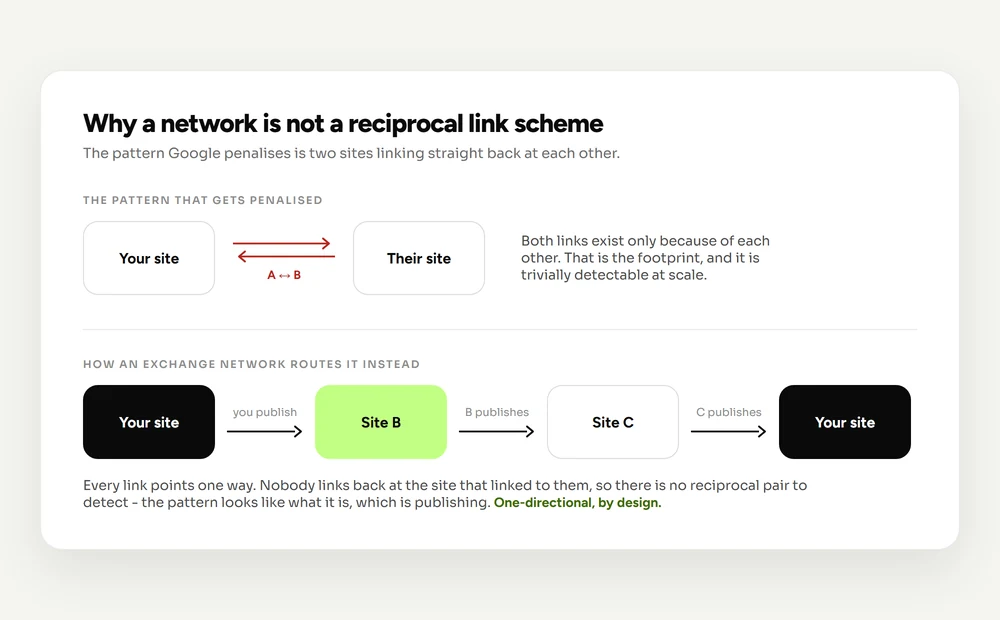
Systematic link exchanges — “I will link to you if you link to me” — are a known pattern that search engines can detect and discount. Occasional natural reciprocal links (two sites in the same industry naturally referencing each other) are fine. But organized link exchange programs create obvious footprints.
Comment and Forum Spam
Dropping links in blog comments, forum posts, and Q&A sites purely for backlinks is spam. Most comment links are nofollow anyway, and the sites that still allow dofollow comment links are typically low-quality. More importantly, this tactic damages your brand reputation.
Auto-Generated and Scraped Content Sites
Links from sites that use auto-generated content, article spinners, or scraped content provide zero value and can actively harm your rankings. These sites exist solely to house links and are exactly the type of site Google’s algorithms are designed to identify and penalize.
Irrelevant Directory Submissions
While legitimate, niche-specific directories still provide value, submitting your site to hundreds of generic web directories is an outdated tactic. Mass directory submissions create unnatural link patterns and waste time that could be spent on strategies that actually work.
Tired of Guessing Whether Links Are Safe?
Consolety removes the risk. Every site in our network is verified for real traffic, genuine content, and editorial integrity. Build your backlink profile with confidence.
How to Check Your Backlinks
Regularly auditing your backlink profile is essential for maintaining and improving your search rankings. Here is how to approach it.
Google Search Console
Google Search Console is the most authoritative source for backlink data because it comes directly from Google. The “Links” report shows your top linked pages, top linking sites, and top linking text. While the data is not as detailed as third-party tools, it reflects what Google actually sees and counts.
Third-Party Backlink Tools
Tools like Ahrefs, Moz, Semrush, and Majestic maintain their own web crawlers and link databases. They provide more detailed analysis than Search Console, including metrics like Domain Rating, spam scores, and historical link data. However, no third-party tool has a complete picture of all links on the web.
For a step-by-step walkthrough of using these tools effectively, see our complete backlink checker guide.
What to Look for in a Backlink Audit
When reviewing your backlink profile, pay attention to:
- Toxic links: Links from spammy, low-quality, or penalized sites. These may need to be disavowed.
- Lost links: High-value links that have disappeared. The linked page may have been removed or the URL may have changed. Sometimes a quick outreach email can restore a lost link.
- Anchor text distribution: Is your anchor text profile diverse and natural, or is it dominated by exact-match keywords?
- Link velocity: Are you gaining and losing links at a natural rate? Sudden spikes or drops warrant investigation.
- Competitor comparison: How does your backlink profile compare to sites that outrank you? Identifying their link sources can reveal opportunities for your own strategy.
The Disavow Tool
Google’s Disavow Tool allows you to tell Google to ignore specific backlinks when assessing your site. This is a last resort for dealing with toxic links that you cannot get removed through outreach. Use it carefully — disavowing legitimate links can hurt your rankings.
Only disavow links when you have clear evidence they are harmful (obvious spam, known PBNs, or links associated with a manual penalty) and you have already attempted to have them removed through direct contact with the linking site.
Backlinks and Content: The Connection
Content and backlinks are deeply intertwined. You cannot build sustainable backlinks without quality content, and even the best content struggles to rank without backlinks. Understanding this relationship is key to an effective SEO strategy.
The Content-First Approach
The most successful backlink builders start with content. Before reaching out for links or launching any link building campaign, they create content that genuinely deserves to be linked to. This means:
- Identifying topics where you can provide unique value or perspective
- Creating content that is measurably better than what currently ranks
- Formatting content for easy scanning and reference (clear headings, tables, key takeaways)
- Including original data, insights, or tools that others would want to cite
Content Types That Attract Backlinks
Based on analysis of millions of web pages, certain content formats consistently attract more backlinks:
- Original research (data studies, surveys): Content that presents new data is inherently linkable because it provides something other creators cannot replicate.
- Ultimate guides and pillar pages: Comprehensive resources become reference points that other articles link to when covering related subtopics.
- “Why” and “what” explainer content: Educational content that clearly explains concepts attracts links from other educational resources.
- Free tools and templates: Practical resources that save people time generate links from articles that recommend useful tools.
- Contrarian and opinion-driven content: Well-argued perspectives that challenge conventional wisdom earn links from both supporters and critics.
The Pillar-Cluster Model
Modern content strategy uses a pillar-cluster model where comprehensive pillar pages (like this one) link to more specific cluster pages. This internal linking structure passes authority throughout your site while providing external sites with a clear page to link to for any given topic.
When someone wants to link to a resource about backlinks, a comprehensive pillar page is far more link-worthy than a thin 500-word overview. The depth and completeness of your content directly affects its ability to attract backlinks.
Get Backlinks Through Quality Guest Posts
Write for real publications in your niche and earn editorial backlinks that move the needle. Consolety matches you with verified site owners looking for quality content.
The Future of Backlinks
As search engines evolve, the role of backlinks is shifting. Understanding where things are headed helps you build a link profile that will remain valuable regardless of algorithm changes.
Quality Over Quantity — More Than Ever
The trend is unmistakable: each algorithm update further devalues low-quality links and increases the impact of high-quality ones. A single link from a trusted, relevant, high-traffic site can now move the needle more than dozens of links from mediocre sources.
This means the old metrics-chasing approach — pursuing any link with a high Domain Authority score regardless of relevance — is increasingly ineffective. The sites winning at SEO in 2026 focus on earning links that drive real referral traffic, not just links that look good in a spreadsheet.
AI and Link Evaluation
Google’s AI systems, including SpamBrain and its successors, are transforming link evaluation. These systems can identify manipulative link building patterns that would be invisible to rule-based algorithms. They can detect coordinated link schemes, recognize artificially created content used for link hosting, and identify unnatural linking patterns across the web.
For legitimate site owners, this is good news. As AI gets better at detecting manipulation, the value of genuine editorial links increases. Sites that invest in authentic relationships and quality content are rewarded, while those relying on schemes face growing risk.
Brand Mentions and Implied Links
Google has patented technology to use unlinked brand mentions as a ranking signal — essentially treating a mention of your brand name as an “implied link” even without an actual hyperlink. While the extent to which this is used in practice is debated, it underscores Google’s movement toward understanding authority and reputation beyond just link counting.
Entity-Based SEO
Search engines are increasingly understanding websites as entities within a knowledge graph rather than just collections of pages with links between them. Being recognized as an authoritative entity in your space — through consistent branding, verified information, and credible associations — is becoming as important as traditional link building.
The Enduring Value of Links
Despite speculation about backlinks losing importance, the reality is that links remain one of the most reliable signals of quality on the web. Until search engines develop a better way to measure editorial endorsement and trust, backlinks will continue to play a central role in rankings.
What is changing is not whether backlinks matter, but which backlinks matter. The bar for what constitutes a valuable link continues to rise. Adapting to this reality by focusing on authentic, verified link building — rather than volume-based tactics — is the only sustainable approach.
Getting Started: Your Backlink Action Plan
Whether you are starting from zero or looking to improve an existing backlink profile, here is a practical action plan to follow.
Step 1: Audit Your Current Profile
Use Google Search Console and a third-party tool to understand your current backlink situation. How many referring domains do you have? What is the quality distribution? Are there any toxic links that need attention? Our backlink checker guide walks you through this process in detail.
Step 2: Analyze Your Competitors
Identify the sites that outrank you for your target keywords and analyze their backlink profiles. Look for patterns: Which types of sites link to them? What content has attracted the most links? This analysis reveals the link building opportunities most relevant to your niche.
Step 3: Create Link-Worthy Content
Based on your competitor analysis and industry knowledge, create content specifically designed to attract backlinks. Focus on formats that perform well in your niche — whether that is original research, comprehensive guides, free tools, or visual content.
Step 4: Build Relationships
Start connecting with site owners, bloggers, and journalists in your industry. Follow them on social media, comment thoughtfully on their content, and look for opportunities to collaborate. Guest posting is one of the most effective ways to build these relationships while earning quality backlinks.
Step 5: Launch Outreach Campaigns
With great content in hand and relationships developing, begin targeted outreach. Pitch guest posts to relevant publications, suggest your content as a resource for existing articles, and pursue broken link building opportunities.
Step 6: Monitor and Iterate
Track your backlink growth, monitor the impact on rankings and traffic, and refine your approach based on what works. Link building is an ongoing process, not a one-time project.
For those looking for a structured way to find legitimate guest posting opportunities and earn verified backlinks, explore how Consolety streamlines this process.
Key Takeaways
- Backlinks are links from other websites to yours and remain one of the top ranking factors in search engine algorithms.
- Quality trumps quantity — a single backlink from a relevant, authoritative site is worth more than dozens of links from low-quality sources.
- The most valuable backlink types are editorial links and guest post links from legitimate, verified publications.
- Avoid PBNs, paid link schemes, and any tactic that creates unnatural link patterns. The risk of penalties far outweighs any short-term gains.
- A sustainable backlink strategy starts with creating genuinely valuable content that people want to reference and share.
- Regularly audit your backlink profile to identify toxic links, recover lost links, and track your progress.
- Guest posting on quality, relevant sites remains one of the most effective and scalable ways to earn real backlinks.
- Search engines are getting better at detecting manipulation — investing in authentic link building is the only approach that stands the test of time.
Check Your Backlinks + Try Consolety
Your backlink profile is the foundation of your search visibility. Start by understanding where you stand, then build on that foundation with verified, quality backlinks from Consolety’s network of real site owners.
- Audit first: Use our backlink checker guide to assess your current profile.
- Build smarter: Connect with verified sites for guest posting opportunities that earn real editorial backlinks.
- Grow sustainably: Explore Consolety’s features and join a network that values quality over shortcuts.
Frequently Asked Questions
How many backlinks do I need to rank on the first page of Google?
There is no fixed number. The backlinks needed depend on your keyword difficulty, your current domain authority, and the strength of competing pages. For low-competition keywords, a handful of quality backlinks may suffice. For highly competitive terms, you may need hundreds of referring domains. Focus on consistently earning quality links rather than chasing a specific number.
Are nofollow backlinks worthless?
No. Since 2019, Google treats nofollow as a hint rather than a directive, meaning it may still pass some value. Beyond SEO, nofollow links from high-traffic sites drive referral visitors, build brand awareness, and contribute to a natural-looking link profile. A healthy backlink profile includes a mix of dofollow and nofollow links.
How long does it take for a new backlink to affect rankings?
It depends on how quickly search engines crawl and index the linking page. Typically, you can expect to see the impact of a new backlink within a few weeks to a few months. Links from frequently crawled, high-authority sites are discovered and counted faster than links from smaller sites that are crawled less often.
Can backlinks hurt my site?
Yes. Low-quality, spammy, or manipulative backlinks can lead to algorithmic penalties or manual actions from Google. This is why it is important to regularly audit your backlink profile and disavow toxic links. That said, Google has stated that for most sites, their algorithms can identify and ignore bad links without penalizing the target site. The main risk comes from actively participating in link schemes.
Is guest posting still a valid backlink strategy in 2026?
Absolutely — when done correctly. The key is contributing genuinely valuable content to legitimate publications with real audiences. What Google penalizes is mass-produced, low-quality guest posts on sites that exist solely for link building. A thoughtful guest post on a relevant, verified publication is one of the best backlinks you can earn. Platforms like Consolety help you find these legitimate opportunities by verifying every site in the network.
What is the difference between backlinks and internal links?
Backlinks (also called external links or inbound links) come from other websites to yours. Internal links connect pages within your own website. Both pass authority and help search engines understand your site, but backlinks carry more weight for rankings because they represent endorsements from external sources — votes of confidence from the wider web.
Should I focus on getting backlinks or creating content first?
Content comes first. You need something worth linking to before you can effectively build backlinks. Start by creating high-quality, comprehensive content for your most important topics. Once you have a strong content foundation, shift to active link building through guest posting, outreach, and relationship building. The two strategies reinforce each other — effective link building amplifies great content, and great content makes link building easier.
How can I get backlinks for free?
There are several ways to earn backlinks without a budget: create exceptional content that naturally attracts links, participate in industry forums and communities, respond to journalist queries through HARO and similar platforms, build relationships with other site owners, pursue broken link building, and list your site in relevant free directories. For a complete list of tactics, see our guide to getting free backlinks.